For a good portion of my 40 years on this Earth, I've stumbled around from job to job, hobby to hobby, desperately searching for something- anything.
Family and friends rolled their eyes and patted me on the head sympathetically every time I enrolled myself in yet another course. I've done everything from Candle Making to Sign Language, Pottery, embroidery, beading, calligraphy....
I'm not sure who I was trying to convince when I assured them that this time, this was it, this was the one thing that would make me happy... until the next time.
But one thing remained constant. It sat in the back of my mind, sometimes quite dormant, at others it was all I could think about. That thing was to write a book and see my name in print.
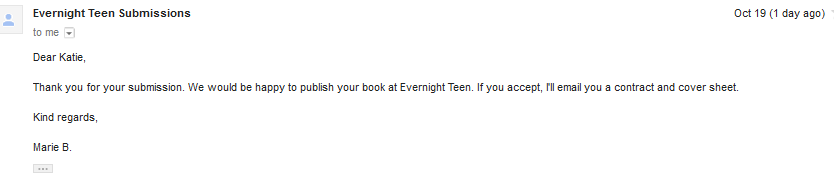
I didn't know my entire life could be summed up in one sentence. My last blog, I was bemoaning the pain of rejection, but I knew that I'd see my name on a book cover, I just couldn't imagine how soon it would be!
I'm gonna be a published author!
Saturday, 26 October 2013
Monday, 14 October 2013
The waiting game...
Nothing beats that thrill of finishing the last chapter of edits from your critique partners and beta readers, then shouting out to the world, here it is! I have finished a whole manuscript! Awwooooga!
But what do I do with it now?
The next step in this whole crazy process is to submit your precious baby to the whim of the publishers. For me, this was most probably even scarier than writing the darned thing. How do you write a query letter that stands out, calls to publishers, drives them to want to read your novel and then, god forbid, publish it??
For me, it was a case of reading other successful author's letters, and putting something together that shows who you are and what your novel is about. It wasn't easy.
The first time I hit the submit button to a publisher, I thought I would pass out, vomit or possibly even both. But after that first click, it became like a drug, I needed to submit! I had to! So submissions were sent to another three publishers without a second thought.
Now! Come publishers, bow down before me and beg and plead to publish it.
Isn't that how it should be....?
Unfortunately not, as I sat in front of my email window hitting F5 every three seconds.
Fast forward two weeks, I've finally gotten over my refresh addiction. The keyboard is quiet, except for the occassional clattering of keys as I play around on Google.
Then one not so interesting evening, where nothing much really happened. My email pinged. There was no bells or whistles or chanting. It was just there.
The answer was, sorry, but no.
I strangely thought that I'd fall in a heap wailing and moaning, screaming why me and sobbing into a tear stained hanky.
But I was unusually calm about it. Was it perhaps because it wasn't one of my main publisher targets? Was it because I had pretty much built myself up for rejection anyway so it wasn't really a surprise?
I can't quite put my finger on it. It could also have something to do with the fact that my second work in progress is starting off nicely and I feel it is so much better written so the first attempt is more of an embarrassment really. One of those things you chalk up to inexperience.
But I think, in the end, each rejection is a step closer to the ultimate publishing goal.
Never give up. Never surrender. I will see my name in print one day. I just know it.
But what do I do with it now?
The next step in this whole crazy process is to submit your precious baby to the whim of the publishers. For me, this was most probably even scarier than writing the darned thing. How do you write a query letter that stands out, calls to publishers, drives them to want to read your novel and then, god forbid, publish it??
For me, it was a case of reading other successful author's letters, and putting something together that shows who you are and what your novel is about. It wasn't easy.
The first time I hit the submit button to a publisher, I thought I would pass out, vomit or possibly even both. But after that first click, it became like a drug, I needed to submit! I had to! So submissions were sent to another three publishers without a second thought.
Now! Come publishers, bow down before me and beg and plead to publish it.
Isn't that how it should be....?
Unfortunately not, as I sat in front of my email window hitting F5 every three seconds.
****
Fast forward two weeks, I've finally gotten over my refresh addiction. The keyboard is quiet, except for the occassional clattering of keys as I play around on Google.
Then one not so interesting evening, where nothing much really happened. My email pinged. There was no bells or whistles or chanting. It was just there.
The answer was, sorry, but no.
I strangely thought that I'd fall in a heap wailing and moaning, screaming why me and sobbing into a tear stained hanky.
But I was unusually calm about it. Was it perhaps because it wasn't one of my main publisher targets? Was it because I had pretty much built myself up for rejection anyway so it wasn't really a surprise?
I can't quite put my finger on it. It could also have something to do with the fact that my second work in progress is starting off nicely and I feel it is so much better written so the first attempt is more of an embarrassment really. One of those things you chalk up to inexperience.
But I think, in the end, each rejection is a step closer to the ultimate publishing goal.
Never give up. Never surrender. I will see my name in print one day. I just know it.
Sunday, 22 September 2013
Do readers give a **** about adverbs?
It was a dark and stormy night, or was it a wild and windy night? Or perhaps it was just night...
A recent event got me thinking about various anomalies such as adverbs, verbs, nouns, subjunctives and the like and what, in actual fact, are they?
Do readers (and I mean readers, not authors who read - in my mind these are two very different categories of people) actually care if writing is full of them or not?
At this juncture, I must make a confession. While I can spell, and my grammar is relatively okay, it is all pretty inate. By that I mean, it's built in. I can structure a sentence but apart from the 'noun' I couldn't tell you wish was the verb, adverb or whatever. I just know what sounds right and what doesn't.
But why are authors so obsessed with these things? Is it a prerequisite of garnering an elusive publishing contract?
Which made me pose the question, do readers actually give a crap or do they just want to be taken on a journey and enjoy the trip? Do they count how many adverbs the author uses? Or count how many times you use the word just? Before I became a writer, I know I certain didn't give a rats backside.
After a recent reading, it was made apparent to me that my writing is somewhat adverb heavy. Adverbs, for those that like me who needed to Google it, are those cheeky little monkeys that tell us when or how or in what manner something was done.
While they seem to be considered the devil by a large component of the authoring community, in my mind, these descriptive little words are what gives the reader a sense of emotion, place, time.
How do you inject more emotion, more feeling into characters without them?
I'll give you some examples of what I mean...
"I silently stared..." If this was changed to 'I stared', would readers assume that it was done silently? One could gasp while staring, scream while staring, talk while staring, mumble while staring. I would not instantly assume that if one stared, it would be done silently.
"My stomach grumbled viciously..." Again, would it be assumed that a stomach would grumble viciously? It is my belief that stomachs may grumble low, perhaps quietly, I don't know. But to indicate the severity of the hunger, I have stated that it grumbled viciously.
As a new writer, I am still learning about the 'craft' of writing and I fear I may fall into the trap of counting adverbs or the number of times I use the word just, then, and or actually, instead of focusing on whether I've written an engaging, memorable image for readers.
But like Goldilock's proverbial porridge, how do you know what is too much, what is not enough, and what is just right? I fear I may never know!
A recent event got me thinking about various anomalies such as adverbs, verbs, nouns, subjunctives and the like and what, in actual fact, are they?
Do readers (and I mean readers, not authors who read - in my mind these are two very different categories of people) actually care if writing is full of them or not?
At this juncture, I must make a confession. While I can spell, and my grammar is relatively okay, it is all pretty inate. By that I mean, it's built in. I can structure a sentence but apart from the 'noun' I couldn't tell you wish was the verb, adverb or whatever. I just know what sounds right and what doesn't.
But why are authors so obsessed with these things? Is it a prerequisite of garnering an elusive publishing contract?
Which made me pose the question, do readers actually give a crap or do they just want to be taken on a journey and enjoy the trip? Do they count how many adverbs the author uses? Or count how many times you use the word just? Before I became a writer, I know I certain didn't give a rats backside.
After a recent reading, it was made apparent to me that my writing is somewhat adverb heavy. Adverbs, for those that like me who needed to Google it, are those cheeky little monkeys that tell us when or how or in what manner something was done.
While they seem to be considered the devil by a large component of the authoring community, in my mind, these descriptive little words are what gives the reader a sense of emotion, place, time.
How do you inject more emotion, more feeling into characters without them?
I'll give you some examples of what I mean...
"I silently stared..." If this was changed to 'I stared', would readers assume that it was done silently? One could gasp while staring, scream while staring, talk while staring, mumble while staring. I would not instantly assume that if one stared, it would be done silently.
"My stomach grumbled viciously..." Again, would it be assumed that a stomach would grumble viciously? It is my belief that stomachs may grumble low, perhaps quietly, I don't know. But to indicate the severity of the hunger, I have stated that it grumbled viciously.
As a new writer, I am still learning about the 'craft' of writing and I fear I may fall into the trap of counting adverbs or the number of times I use the word just, then, and or actually, instead of focusing on whether I've written an engaging, memorable image for readers.
But like Goldilock's proverbial porridge, how do you know what is too much, what is not enough, and what is just right? I fear I may never know!
Tuesday, 3 September 2013
How is editing like an elephant?
You sit in your comfy lounge chair, computer perched on your lap, swimming in an endless sea of chocolate and coffee.
"I want to write a book, how hard can it be!"
So you type and type and drink more coffee and eat more chocolate and in your complete caffeine and sugar fueled state, you churn out fifty thousand words like butter. To you, they sound like literary genius, how could anyone fault your impeccable wordcraft and ability to tell a fantastic tale with more twists and turns than a formula 1 racing circuit.
No one tells you (well actually they do, but you refuse to listen) that editing is the hard part - beware! You find someone you trust enough to show your writing to and you receive back a document covered in red comment boxes. Your confidence takes a nosedive and you throw your precious manuscript in the dustbin.
After a week or so, those dusty bits of paper lying dormant in the bin starting calling to you. So you pull them out and courageously start to read.
Spelling, grammar and punctuation corrections swim through your work like hungry piranhas. Not to mention the plot holes, clunky sentence structure and the completely confused timeline you have created.
But, you take a deep breath, read over the comments and make some changes. Small at first, then you find yourself bravely cutting huge chunks of superfluous junk from your manuscript. You read back through your edited work and realise that perhaps those authors who critiqued for you might actually know a thing or two.
And so begins the editing process. Going through each sentence, line by line thinking how could it be better? Does it add to the story or can I cut it completely? You spend hours pouring over words, phrases, sentences and paragraphs trying to find the right way to say something. It might take weeks to get through one chapter.
You update, fix and repair and send it back for another check over. Gradually, the number of red boxes reduce. But not only do the red boxes reduce, instead of screaming, "fix this!", they now say, "great writing," or, "this works really well.."
While editing has been one of the most challenging parts of this experience so far, it has also been one of the most rewarding. There is nothing like the rush of having a critique person, known for their acute attention to detail and impeccable knowledge of grammar saying that a particular chapter is "stunning" and they didn't make a lot of notes because the story was so engaging that they just got lost in the story.
So some sage advice from one newbie writer to another; don't be afraid of the edit, but don't expect to have everyone that critiques your work fawn all over you as if you were the next J.K. Rowling. Editing is a very long and often difficult process and if you don't break it down, it will swallow you whole.
So what has all this got to do with elephants?
Well, how do you eat one?
A lot like editing, one bite at a time...
"I want to write a book, how hard can it be!"
So you type and type and drink more coffee and eat more chocolate and in your complete caffeine and sugar fueled state, you churn out fifty thousand words like butter. To you, they sound like literary genius, how could anyone fault your impeccable wordcraft and ability to tell a fantastic tale with more twists and turns than a formula 1 racing circuit.
No one tells you (well actually they do, but you refuse to listen) that editing is the hard part - beware! You find someone you trust enough to show your writing to and you receive back a document covered in red comment boxes. Your confidence takes a nosedive and you throw your precious manuscript in the dustbin.
After a week or so, those dusty bits of paper lying dormant in the bin starting calling to you. So you pull them out and courageously start to read.
Spelling, grammar and punctuation corrections swim through your work like hungry piranhas. Not to mention the plot holes, clunky sentence structure and the completely confused timeline you have created.
And so begins the editing process. Going through each sentence, line by line thinking how could it be better? Does it add to the story or can I cut it completely? You spend hours pouring over words, phrases, sentences and paragraphs trying to find the right way to say something. It might take weeks to get through one chapter.
While editing has been one of the most challenging parts of this experience so far, it has also been one of the most rewarding. There is nothing like the rush of having a critique person, known for their acute attention to detail and impeccable knowledge of grammar saying that a particular chapter is "stunning" and they didn't make a lot of notes because the story was so engaging that they just got lost in the story.
So some sage advice from one newbie writer to another; don't be afraid of the edit, but don't expect to have everyone that critiques your work fawn all over you as if you were the next J.K. Rowling. Editing is a very long and often difficult process and if you don't break it down, it will swallow you whole.
So what has all this got to do with elephants?
Well, how do you eat one?
A lot like editing, one bite at a time...
Thursday, 29 August 2013
'Because of Lucy' by Lisa Swallow - Cover Reveal & Release!!!
This wonderful gem from one of my favourite authors, Lisa Swallow is now available on Amazon!
Because
of Lucy Cover Reveal Information
Coming August 2013…
Synopsis:
"In
life, there are some people you have to lose in order to find yourself."
Ness’s parents are shocked when she turns
down her place at Leeds University and takes on a full-time job in a call
center. Determined to begin her adult life the way she wants, Ness moves to
Leeds to live with her best friend Abby.
One night she meets Evan, who is everything
she hates about guys. He may be hot but he’s also drunken, arrogant, and on top
of that, he apparently has sex with girls and forgets about it. But Evan isn't
what he seems and Ness soon discovers they have more in common than she
thought.
Evan is struggling to escape from his past
too, and when Lucy appears she threatens his new relationship with Ness. Unsure
if she can deal with the effect Lucy has on Evan, Ness makes a decision about
her future which pulls them apart.
When their new lives don't go as planned,
Ness and Evan are both faced with difficult choices. All because of Lucy.
*Recommended
17+ due to strong language and sexual content*
ABOUT
THE AUTHOR:
Lisa was born in
the UK and she moved around Europe with her military family before completing a
BA (Hons) in English at the University of Leeds. Her home is now in Perth,
Australia with her husband and three children. Lisa has written since she was a
child - moving from writing poems and short stories aged nine to writing novels
in the last few years. With the encouragement of her family and local writers
group, Lisa found the confidence to share her latest paranormal romance series
with the world.
In between running
her home based craft supplies business, looking after her family, and writing,
Lisa sometimes finds spare time to do other things. This often involves
swapping her book worlds for gaming worlds. She even leaves the house
occasionally, enjoying walks with her dog and time with her family. She loves
all things from the Whedonverse and preferred vampires before they sparkled.
Lisa enjoys
reading both classics and modern fiction. Her favorite genres are gothic,
paranormal and urban fantasy, but she also enjoys contemporary new adult. She
is currently working on more books in the Soul Ties series, and has other
projects lined up waiting.
Facebook: www.facebook.com/lisaswallowbooks
Twitter: www.twitter.com/lisa_swallow_au
Website: www.lisaswallow.net
Wednesday, 14 August 2013
Letter from my 6 year old self.
I have loved to write since I was young, I've just found proof.
My Mum was going through some old boxes the other day and came across something pretty special. One of the first stories I ever wrote, I was 6 years old. It's even illustrated.
I just wanted to share this with everyone.
My Mum was going through some old boxes the other day and came across something pretty special. One of the first stories I ever wrote, I was 6 years old. It's even illustrated.
I just wanted to share this with everyone.
Friday, 2 August 2013
So you want to write a book...
In the immortal words of Ferris Bueller, "life is what happens while you're making other plans. If you don't stop and look around once in a while you could miss it."
When my dad asked me the all important question when I was 6 what I wanted to be when I grew up, I knew then I wanted to be an author. That was 34 years ago. Somewhere along the line, I got a little lost.
But wanting something and getting it are two very different beasts. One of the hardest things about becoming an author is knowing how to get a foot in that gilded, golden door before someone else younger, smarter and with a much better idea body slams you out the way on their way through.
That was until 6 weeks ago when I met a local author which set the proverbial snowball in motion. I was introduced to a couple of people, who put me in touch with a couple more people, who knew even MORE people. All of them craftsmen in their own right and truly amazing humans, each and every one. All of a sudden I was talking to real live published authors and now I find myself sitting in front of a 50,000 word manuscript and hoping beyond hope, that a publisher might offer me a contract.
If I have one piece of advice for writers just starting out and looking for that elusive way in, one very effective way is networking. Talk to people, make contacts. Go to book launches, readings, sessions at your local Writer's Centre and talk to people. Don't just sit in the corner hiding and leave when it's over, get out of your comfort zone. Go and talk to the author, introduce yourself to other writers AND not forgetting the most important group of people, the readers! Get on social media, join some author groups, there is an abundance of information and help just waiting for you to tap into it.
As it turns out, authors are not the frightening, unapproachable rock-stars I thought of them as. They are the ones that will help you with your first draft, help you with critiquing and beta reading, and you will find these amazing people becoming lifelong friends. They have been where you are and can provide more advice than just doing the occasional writing course and hoping magically publishers will fall all over themselves to get your manuscript.
These people will become your support network when you are feeling low, hate what you've written and are close to binning the lot, can't find the write word or phrase, need to get more words out or just need to vent.
The only other snippet I would offer at this juncture is; be prepared to have to work hard, you aren't going to be able to give up your day job on your first book sales, or your second, or even your third. Write because you love to write.
It won't come to you, you have to go and get it, grab it and hold on.
When my dad asked me the all important question when I was 6 what I wanted to be when I grew up, I knew then I wanted to be an author. That was 34 years ago. Somewhere along the line, I got a little lost.
But wanting something and getting it are two very different beasts. One of the hardest things about becoming an author is knowing how to get a foot in that gilded, golden door before someone else younger, smarter and with a much better idea body slams you out the way on their way through.
That was until 6 weeks ago when I met a local author which set the proverbial snowball in motion. I was introduced to a couple of people, who put me in touch with a couple more people, who knew even MORE people. All of them craftsmen in their own right and truly amazing humans, each and every one. All of a sudden I was talking to real live published authors and now I find myself sitting in front of a 50,000 word manuscript and hoping beyond hope, that a publisher might offer me a contract.
If I have one piece of advice for writers just starting out and looking for that elusive way in, one very effective way is networking. Talk to people, make contacts. Go to book launches, readings, sessions at your local Writer's Centre and talk to people. Don't just sit in the corner hiding and leave when it's over, get out of your comfort zone. Go and talk to the author, introduce yourself to other writers AND not forgetting the most important group of people, the readers! Get on social media, join some author groups, there is an abundance of information and help just waiting for you to tap into it.
As it turns out, authors are not the frightening, unapproachable rock-stars I thought of them as. They are the ones that will help you with your first draft, help you with critiquing and beta reading, and you will find these amazing people becoming lifelong friends. They have been where you are and can provide more advice than just doing the occasional writing course and hoping magically publishers will fall all over themselves to get your manuscript.
These people will become your support network when you are feeling low, hate what you've written and are close to binning the lot, can't find the write word or phrase, need to get more words out or just need to vent.
The only other snippet I would offer at this juncture is; be prepared to have to work hard, you aren't going to be able to give up your day job on your first book sales, or your second, or even your third. Write because you love to write.
It won't come to you, you have to go and get it, grab it and hold on.
Subscribe to:
Posts (Atom)


